|
|
Pre-Award and Research Development
|
|
October 16, 2026
|
|
|
|
|
|
|
|
|
Congratulations, Dr. Zuker!
Dr. Charles Zuker was awarded the 2026 Wolf Prize in Medicine for his discoveries on the sense of taste, including the cells and receptors that detect the five basic taste qualities and how taste information is represented in the brain.
|
|
|
Congratulations, Dr. Churchland!
Dr. Mark Churchland received a subaward on an NIH BRAIN Initiative TMM R01 renewal led by Dr. Shreya Saxena at Yale, "Embodied Models for Investigating Multi-regional Contributions Towards Compositional Motor Control."
|
|
|
|
|
|
HHMI Hanna H. Gray Fellows Program for postdocs, open to international postdocs.
Key eligibility: No more than 7 years of postdoctoral experience. International postdocs eligible. Up to two years of postdoc support, with a pathway to the Freeman Hrabowski Scholars Program in faculty position. Competition held every other year.
Applications open November 3; Deadline: December 15. Info webinar: October 22, 2 pm ET.
Please reach out to us if you plan to apply.
|
|
|
|
|
|
Weekly Office Hours
Every Thursday, 2:00-3:00 pm:
Meet the team and ask any questions during office hours.
Click here to join the Zoom meeting.
|
|
|
|
|
|
Schedule time to meet with the team
|
|
|
|
|
|
|
Congratulations to our recent award recipients!
September 18 - October 16, 2026
|
|
|
|
|
|
Postdoc Awards
|
|
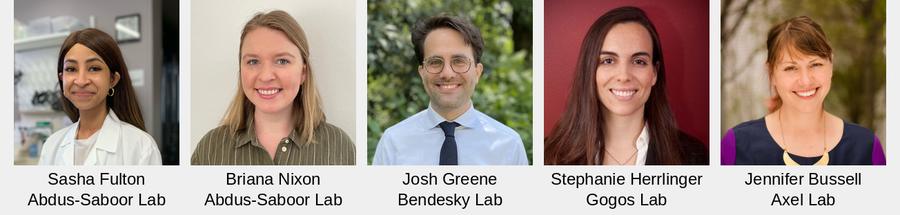
Jennifer Bussell: 2026 BBRF Young Investigator Grant - Orbitofrontal cortex circuits for resolving punishment uncertainty and compulsive information seeking (Axel Lab)
Sasha Fulton: 2026 BBRF Young Investigator Grant - How touch-sensing neurons modulate the brain's stress response (Abdus-Saboor Lab)
Josh Greene: 2026 BBRF Young Investigator Grant - A hypothalamus-to-spinal cord pathway controlling adrenaline release and sustained defensive states (Bendesky Lab)
Stephanie Herrlinger: 2026 BBRF Young Investigator Grant - Disinhibition failure and spatial learning deficits in a 22q11.2 deletion mouse model of schizophrenia (Gogos Lab)
Briana Nixon: 2026 BBRF Young Investigator Grant - Lactation body-brain circuits and the stress response (Abdus-Saboor Lab)
|
|
Principal Investigator Awards
|
|
Mark Churchland: Renewal NIH/NIDA/BRAIN Initiative TMM 2R01DA056377-03 "Embodied Models for Investigating Multi-regional Contributions Towards Compositional Motor Control" (subaward, with PI Dr. Shreya Saxena at Yale)
|
|
|
|
|
Upcoming funding opportunities
|
|
|
|
|
|
Team Grants
|
|
Want to write a large, multi-investigator grant? Come talk to us about planning and executing team grant applications. Schedule a meeting with our team here!
New/Highlighted Team Grant Opportunities
- BRAIN Initiative RM1: Integrative Team-Research BRAIN Circuits Program - iTeamBCP. Supports transdisciplinary research teams seeking to develop mechanistic, biologically grounded explanations of how neural circuits and their cellular building blocks give rise to central nervous system function. Applications must explicitly connect: (1) characterization of circuit components (e.g., cell types and/or connectivity); (2) measurement of dynamic circuit activity, incorporating in vivo CNS recordings at cellular and sub-second temporal resolution; and (3) analyses of a tractable behavior or functional output.. June 23 2027, June 23 2028
- NIMH P50: Silvio O. Conte Centers for Basic Neuroscience or Translational Mental Health Research. Supports integrative, multidisciplinary teams addressing high-risk, high-impact questions in (a) basic brain and behavior research that uncovers mechanisms underlying mental disorders, (b) translation of basic and clinical neuroscience research on severe mental illness, or (c) neurobehavioral mechanisms and developmental trajectories of psychopathology. Up to $2M in direct costs per year. May 25 2027, May 25 2028
- Forecasted: NINDS RM1: Collaborative Opportunities for Multiple-disciplinary, Bold, and Innovative Neuroscience (COMBINE). To pursue a single focused goal to overcome persistent barriers, challenge orthodoxies, achieve paradigm-shifts, or develop new foundational principles in neuroscience.
|
|
|
|
NIH's Highlighted Topics Relevant to ZI Investigators
|
|
|
|
|
|
Established Investigators (view full list on our website)
|
|
|
|
New/Highlighted Funding Opportunities
-
BRAIN Initiative R01: Theories, Models and Methods for Analysis of Complex Data from the Brain. For the development of computational tools (theories, models, methods) for understanding dynamic brain circuits, which will be made broadly accessible to the greater research community. Resubmissions: November 6, 2026, October 6, 2027
-
Simons Foundation: Utilizing the Full Power of Empire AI. Supports 2-year projects that use Empire AI's multinode GPU clusters to build machine-learning foundation models; neuroscience is an eligible field. December 1, 2026
-
Forecasted: BRAIN Initiative Brain-Behavior Quantification and Synchronization – Transformative Research on Behavior at the Organismal Level (BBQS).
-
Forecasted: NIH Small Grant: Building Sustainable Software Tools for Open Science (R03).
-
Forecasted: BRAIN Initiative Development and Validation of Novel Tools and New Approaches for Neuroscience Research. Anticipated deadline: June 10, 2027
Upcoming Funding Opportunities
- NIH Parent R01: New: February 5, June 5, October 5; Renewal/Resubmission: November 5, March 5, July 5
- NIH Parent R21: New: February 16, June 16, October 16; Renewal/Resubmission: November 16, March 16, July 16
|
|
|
|
Early Career Investigators (view full list and timeline on our website)
|
|
|
-
McKnight Scholar Awards: To support exceptional young scientists who are in the early stages of establishing an independent laboratory and research career. Eligibility: must be an Assistant Professor within the first 5 years of starting an independent lab; can apply up to 2 times. November 3, 2026.
-
HHMI Freeman Hrabowski Scholars Program: Up to 10 years of support for outstanding early-career tenured and tenure-track faculty, including physician-scientists. December 15
-
Katz Early Stage Investigator Research Project Grant (R01): Supports an innovative project that represents a change in research direction for an early stage investigator (ESI) and for which no preliminary data exist. New: January 26, May 28; Resubmission: October 27, February 26
-
Klingenstein Fellowship Awards in Neuroscience: Supports early-career investigators within the first four years of completion of last postdoc. February 1
|
|
|
|
Post-Docs (view full list and timeline on our website)
|
|
|
-
NIH Parent F32 NRSA: U.S. citizen/permanent resident; 1st - 3rd year postdoc. December 8, April 8, August 8
-
HHMI Hanna H Gray Postdoc-to-Faculty transition award: No more than 7 years of postdoc experience; international postdocs are eligible. Competition occurs every other year; applications open November 3. December 15
-
Simons Foundation Fellows-to-Faculty Award: Up to 2 years of postdoc support plus a faculty phase. For postdocs going on the faculty job market in fall 2027 whose research fits SFARI (autism), SCPAB (plasticity and the aging brain; final cycle), or SCENE (ecological neuroscience); international applicants eligible. January 13, 2027
-
Dompé Foundation Scholarships for Neuroscience and Neurobiology: For PhD students and postdocs of any nationality at U.S. universities studying neuroscience/neurobiology. January 31, 2027
-
Jane Coffin Childs Postdoctoral Fellowship: Ph.D. conferred no more than 24 months before the deadline and have no more than 12 months of postdoctoral research experience; international postdocs eligible. February 1, 2027
-
NIH K32 Academic Career Excellence (ACE) Award: U.S. citizen/permanent resident; 1st - 2nd year postdoc. February 12, June 12, October 12
-
NIH Parent K99/R00 Pathway to Independence Award: 1-2 years of postdoc + 3 years of faculty funding. International applicants eligible. 3rd - 4th year postdocs. New: February 12, June 12, October 12. Resubmission: November 12, March 12, July 12
-
NIH Parent K01 Mentored Scientist Development Award: U.S. Citizens/Permanent Residents; 2nd - 5+ year postdocs. New: February 12, June 12, October 12. Resubmission: November 12, March 12, July 12
*check with us regarding eligibility extensions for NIH grants
|
|
|
|
|
Graduate Students (view full list and timeline on our website)
|
|
|
-
NSF Graduate Research Fellowship Program (GRFP): Pre-grad, first or second year Ph.D.; U.S. citizen/permanent resident; Cannot have a master’s degree. Life Sciences deadline: October 19
-
HHMI Gilliam Fellows Program: Second- and third-year PhD students; open to US citizens/permanent residents, DACA recipients, and international students. October 27 2026.
-
Paul & Daisy Soros Fellowships for New Americans: First or second year Ph.D.; Less than 31 years old; Must be an immigrant or child of immigrants; U.S. citizen/permanent resident, DACA, asylee, refugee. October 29, 2026 at 2:00 pm ET
-
Hertz Foundation Fellowship: Pre-grad or first year; U.S. citizen/permanent resident. Deadline: October 30
-
NDSEG Fellowship: Three-year DoD fellowship for early-stage PhD students; U.S. citizens/nationals. October 30, 2026
-
NIH F31: For U.S. citizens/permanent residents. December 8, April 8, August 8.
-
NIH F99/K00: Pre-doc to post-doc transition award: For grad students with 1.5-2 years left of PhD at award start (typically 3rd or 4th year students). Must be a U.S. citizen/permanent resident. December 8, April 8, August 8.
-
Dompé Foundation Scholarships for Neuroscience and Neurobiology: For PhD students and postdocs of any nationality at U.S. universities studying neuroscience/neurobiology. January 31, 2027
|
|
|
|
|
The Future in Mind
The Zuckerman Institute Friday Funding monthly email recaps the latest award wins of our researchers and outlines important upcoming grant deadlines.
|
|
|
|
|
|
|