|
Pre-Award and Research Development |
October 17, 2025 |
|
|
|
|
|
|
|
|
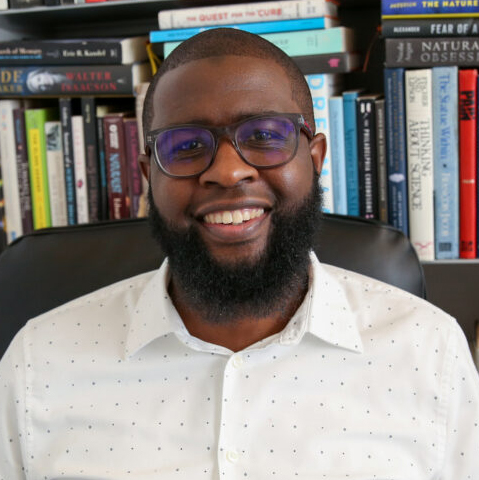
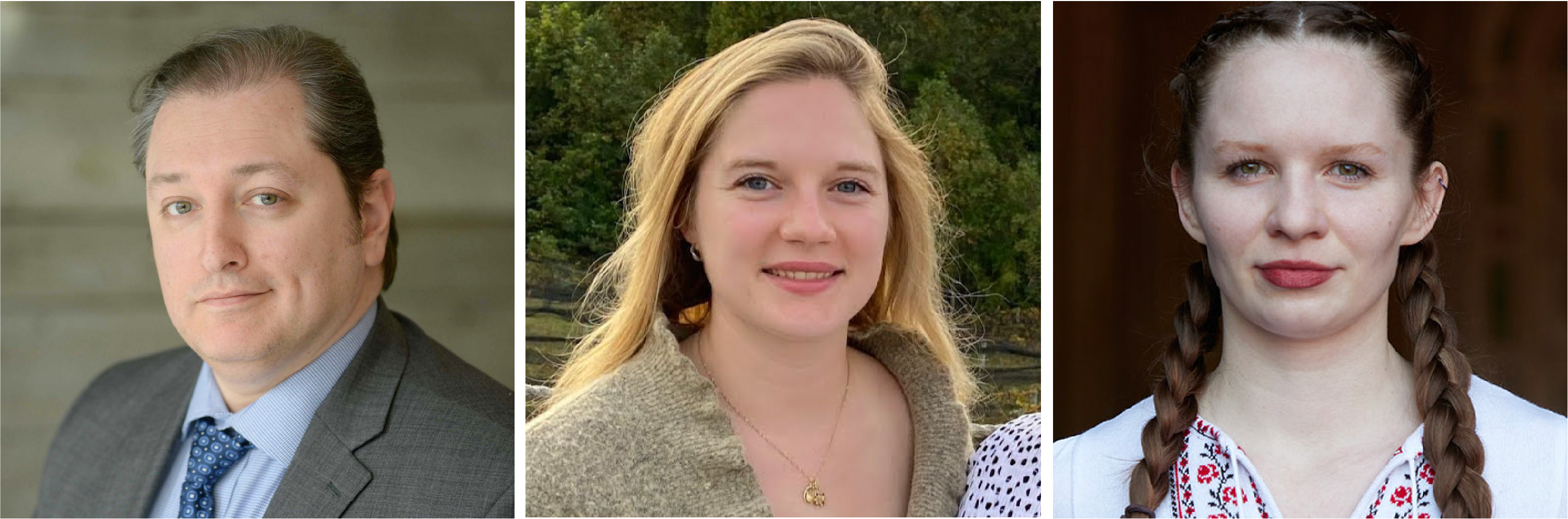
Congratulations, Dr. Abdus-Saboor!
Dr. Ishmail Abdus-Saboor won an NIH Director's Pioneer Award (DP1) for his high-risk, high-reward research direction, investigating the "Role of social touch and social memory in organizing naked mole-rat colonies." |
|
|
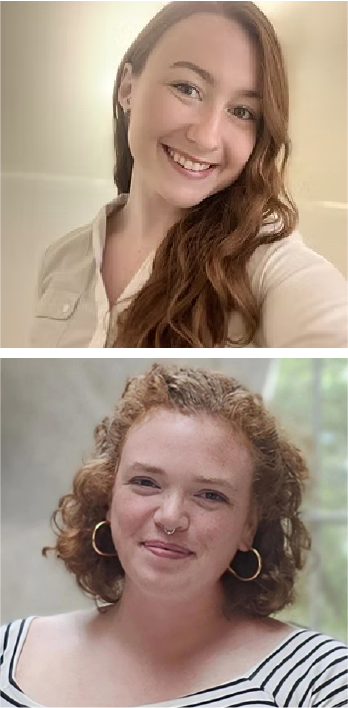
Congratulations, Dr. McDermott and Dr. Merritt!
Dr. Courtney McDermott (Marlin Lab) and Dr. Jennifer Merritt (Bendesky Lab) each won a Kavli Scholar Award.
Dr. McDermott will investigate "Early life stress and its effect on neural circuit formation and function".
Dr. Merritt will study the "Molecular evolution of steroid hormone signaling and its impact on behavior". |
|
|
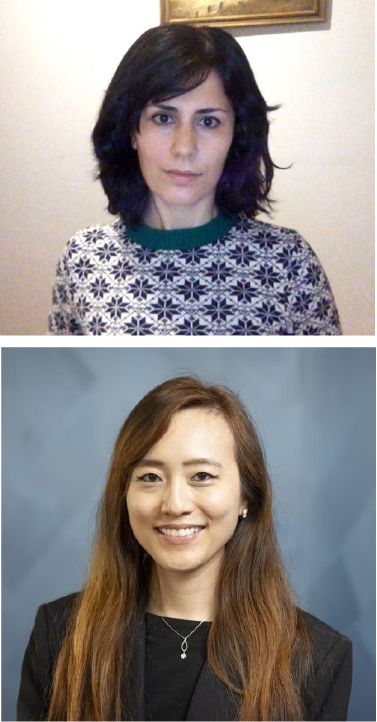
Congratulations, Dr. Kassraian and Dr. Yap!
Dr. Pegah Kassraian (Siegelbaum Lab) and Dr. Lynn Yap (Axel Lab) each won a Brain & Behavior Research Foundation NARSAD Young Investigator Grant.
Dr. Kassraian will investigate the hippocampal basis of social fear processing using a mouse model of schizophrenia.
Dr. Yap will study the role of the medial prefrontal cortex (mPFC) in the consolidation of long-term associative memories and in the integration of sensory inputs to guide flexible goal-directed behaviors. |
|
|
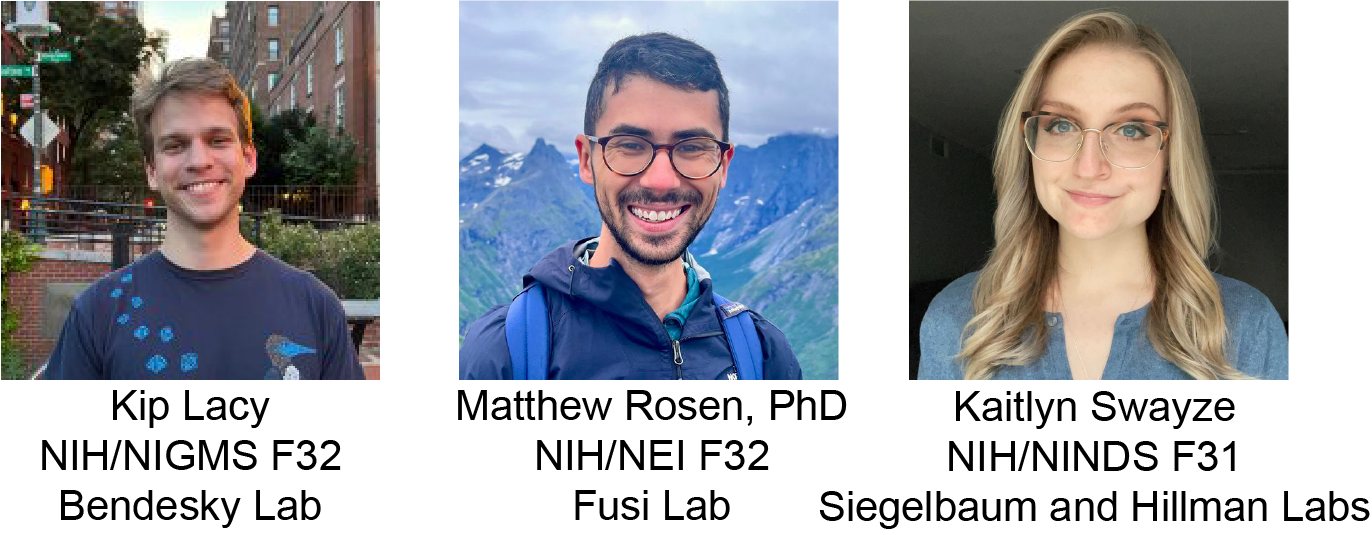
Congratulations, postdocs and graduate students!
Several of our postdocs and graduate students received NIH NRSA Fellowship awards. See below for details. |
|
|
|
|
|
|
Weekly Office Hours
Every Thursday, 2:00-3:00 pm:
Meet the team and ask any questions during office hours.
Click here to join the Zoom meeting. |
|
|
|
|
Schedule time to meet with the team |
|
|
|
|
|
|
Congratulations to our recent award recipients!September 13 - October 17, 2025 |
|
|
|
|
Graduate Student Awards |
Kaitlyn Swayze: NIH/NINDS F31 NS147717-01 "Quantifying relationships between behavior, neural network and metabolic dysfunction in a genetic mouse model of developmental epileptic encephalopathy" (Siegelbaum and Hillman Labs) |
Postdoc Awards |
Kip Lacy: NIH/NIGMS F32 GM161084-01 "Understanding how evolutionary forces shape genomic imprinting and affect healthy development" (Bendesky Lab)
Matthew Rosen: NIH/NEI F32 EY038094-01 "Representation and computation of semantic categories in the dorsal visual stream" (Fusi Lab)
Courtney McDermott: Kavli Scholar Award "Early life stress and its effect on neural circuit formation and function" (Marlin Lab)
Jennifer Merritt: Kavli Scholar Award "Molecular evolution of steroid hormone signaling and its impact on behavior" (Bendesky Lab)
Pegah Kassraian: BBRF YI Grant to "investigate the hippocampal basis of social fear processing" (Siegelbaum Lab)
Lynn Yap: BBRF YI Grant to study "the role of the medial prefrontal cortex (mPFC) in the consolidation of long-term associative memories and in the integration of sensory inputs to guide flexible goal-directed behaviors." (Axel Lab) |
Mid-Career Investigator Awards |
Ishmail Abdus-Saboor: NIH/OD/NCCIH Pioneer Award DP1 AT013723-01 "Role of social touch and social memory in organizing naked mole-rat colonies"
|
|
|
|
|
Upcoming funding opportunities |
|
|
|
|
Team Grants |
Want to write a large, multi-investigator grant? Come talk to us about planning and executing team grant applications. Schedule a meeting with our team here!
New/Highlighted Team Grant Opportunities
- NSF/NIH Collaborative Research in Computational Neuroscience (CRCNS) Program. Innovative Approaches to Science and Engineering Research on Brain Function. NSF deadline: November 12.
- Forecasted: BRAIN Initiative RM1: Integrative Team-Research BRAIN Circuits Program - iTeamBCP. To understand how the nervous system, from its individual components to its unified whole, gives rise to mental experience and behavior. Applications must connect these 3 levels of analysis: (1) rich large-scale information about circuit components (e.g., cell types, connectivity), (2) in vivo CNS recordings at cellular and sub-second and temporal resolution, (3) along with analyses of a tractable behavior of an organism or a well-defined neural system. Estimated Application Due Date: June 16, 2026
- Forecasted: NINDS RM1: Collaborative Opportunities for Multiple-disciplinary, Bold, and Innovative Neuroscience (COMBINE). To pursue a single focused goal to overcome persistent barriers, challenge orthodoxies, achieve paradigm-shifts, or develop new foundational principles in neuroscience. Estimated Application Due Date: June 23, 2026
|
|
|
Established Investigators (view full list on our website) |
|
|
New/Highlighted Funding Opportunities
- BRAIN Initiative R01: Development and Validation of Novel Tools to Probe Cell-Specific and Circuit-Specific Processes in the Brain. For research that will develop and validate novel tools to facilitate the detailed analysis of complex circuits and provide insights into cellular interactions that underlie brain function. June 8 2026, February 8 2027
- BRAIN Initiative R01: New Technologies and Novel Approaches for Recording and Modulation in the Nervous System. Applications for proof-of-concept testing and development of new technologies and novel approaches for recording and modulation of neural cells and circuits, to address major challenges and enable transformative understanding of dynamic signaling in the central nervous system. January 20, 2026
- BRAIN Initiative R01: Theories, Models and Methods for Analysis of Complex Data from the Brain. For the development of computational tools (theories, models, methods) for understanding dynamic brain circuits, which will be made broadly accessible to the greater research community. October 28 2025, October 6 2026
- BRAIN Initiative R21: New Concepts and Early-Stage Research for Recording and Modulation in the Nervous System. For unique and innovative recording and/or modulation technologies that are in the earliest stage of development, including new and untested ideas that are in the initial stages of conceptualization. June 15, 2026
Upcoming Funding Opportunities
- NIH Parent R01: New: February 5, June 5, October 5; Renewal/Resubmission: March 5, July 5, November 5
- NIH Parent R21: New: February 5, June 5, October 5; Renewal/Resubmission: March 16, July 16, November 16
|
|
|
Early Career Investigators (view full list and timeline on our website) |
|
|
- McKnight Scholar Award: Must have an appointment as an assistant professor, and must have served at that rank for less than five years at the application deadline. Cannot apply more than twice for this award. December 1 2025
- Katz Early Stage Investigator Research Project Grant (R01): Supports an innovative project that represents a change in research direction for an early stage investigator (ESI) and for which no preliminary data exist. January 27, May 27, September 28
- Klingenstein Fellowship Awards in Neuroscience: Must be in a tenure-track position and have a maximum of four years between the completion of last postdoc and the application deadline. February 1 2026
|
|
|
|
Post-Docs (view full list and timeline on our website) |
- NIH F32 NRSA Individual Postdoctoral Fellowship
- NIH K99/R00 Pathway to Independence (1-2 years of postdoc + 3 years of faculty funding)
NIH Parent K99/R00: Transition to faculty. International applicants eligible. 3rd - 4th year postdocs. New: February 12, June 12, October 12. Resubmission: November 12, March 12, July 12
- NIH K01 Career Development Award
NIH Parent K01: 2nd - 5+ year postdocs. New: February 12, June 12, October 12. Resubmission: November 12, March 12, July 12
- Life Sciences Research Foundation Postdoctoral Research Award: Must apply within 5 years of receiving Ph.D. or M.D.; must have begun (or will begin) working in your proposed postdoc lab between August 1 of the previous year and July 31 of the upcoming year; Post-doc must be in different lab than Ph.D. October 31
*Check with us regarding eligibility window extensions for NIH grants |
|
|
Graduate Students (view full list and timeline on our website) |
|
|
- NIH F31: For U.S. citizens/permanent residents. December 8, April 8, August 8
- NIH F99/K00 Pre-doc to post-doc transition award
- Forecasted: NIH/NIA Transition to Aging Research for Predoctoral Students F99/K00. must be a U.S. citizen/permanent resident OR non-U.S. citizen with a valid U.S. visa; for grad students with 1.5-2 years left of PhD (typically 3rd or 4th year students). Estimated Application Due Date: February 17, 2026
- Forecasted: NIH Blueprint and BRAIN Initiative ACTION Potential F99/K00: To support a defined pathway across career stages for skilled neuroscience graduate students performing neuroscience research within the missions of the NIH Blueprint and/or BRAIN Initiative. For grad students with 1.5-2 years left of PhD (typically 3rd or 4th year students). Estimated Application Due Date: March 20, 2026
- NSF Graduate Research Fellowship Program (GRFP): Pre-grad, first or second year Ph.D.; U.S. citizen/permanent resident; Cannot have a master’s degree. November 10
- Hertz Foundation Fellowship: Pre-grad or first year; U.S. citizen/permanent resident. Expected deadline: October 31
- Paul & Daisy Soros Fellowships for New Americans: First or second year Ph.D.; Less than 31 years old; Must be an immigrant or child of immigrants; U.S. citizen/permanent resident, DACA, asylee, refugee. October 30
|
|
|
|
The Future in Mind
The Zuckerman Institute Friday Funding monthly email recaps the latest award wins of our researchers and outlines important upcoming grant deadlines.
|
|
|
|
|
|
|